Define the information needed
What needs to be observed, understood or reported.

01 — THE CHALLENGE
Artificial intelligence can analyse, interpret and make decisions.
But to interact with the real world, it needs access to information about its physical surroundings.
A scene, a movement, a thermal signature: before an application can interpret them, they must be made accessible to it.
02 — OUR ANSWER: XPLOCAM
A hardware platform that lets developers connect their AI applications to the physical world, without having to design the electronics and acquisition systems themselves.
For developers, integrators and researchers looking to experiment, build and prepare their perception applications.
XPLOCAM provides the hardware foundation. You develop the application that defines its purpose.
03 — OUR AMBITION: PERCEPTION INFRASTRUCTURE
Designing the architectures and perception nodes that will enable artificial intelligence to be deployed in real-world environments.
On an industrial site, around a perimeter or within a mobile system, the architecture starts with local needs: what to perceive, process and transmit. XPLOCAM provides a foundation for exploring this approach.
What needs to be observed, understood or reported.
Produce information useful to the application, as close as possible to the field.
Account for network conditions and adapt video quality to the available bandwidth.
04 — THE PLATFORM IN PRACTICE
For developers, integrators and researchers: access an integrated acquisition and processing chain, then focus on your application.
Use visible imaging alone, thermal imaging alone or a fusion of both. The sensors are synchronised in hardware and processed through a shared pipeline.
Synchronised sensors · FPGA pipelineBuild perception, video analysis or embedded AI functions on NVIDIA Jetson, with a C++ API and ROS examples.
Linux · Jetson · C++ APITest your application in its intended environment, then prepare its integration with support and expertise from Tachysséma.
Documentation · Examples · SupportHardware paves the way for software.
You define the application. XPLOCAM provides the foundation to explore it.
VISIBLE AND THERMAL VISION — A REAL-WORLD TEST
Live visible and thermal streams of the same scene, accessible from a remote workstation. On the left, thermal information is overlaid on the visible image in real time to highlight the subject. On the right, thermal imaging alone.
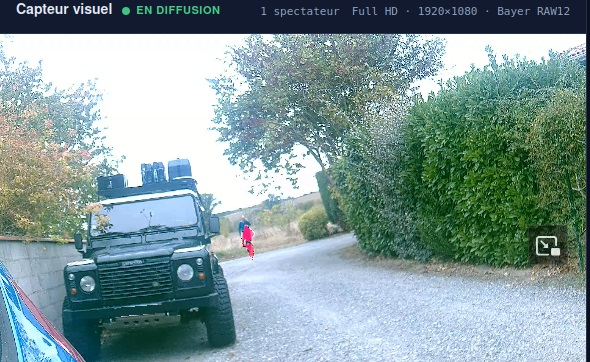
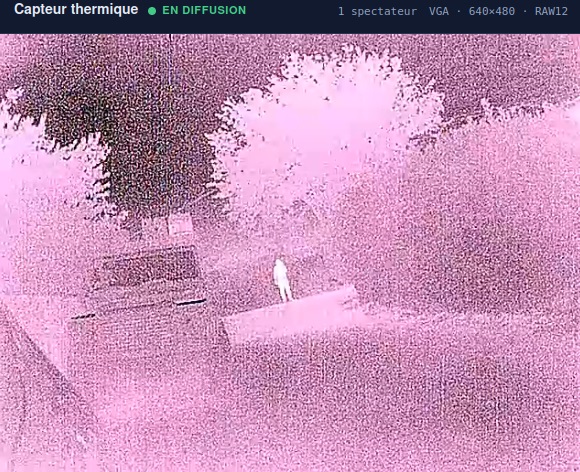
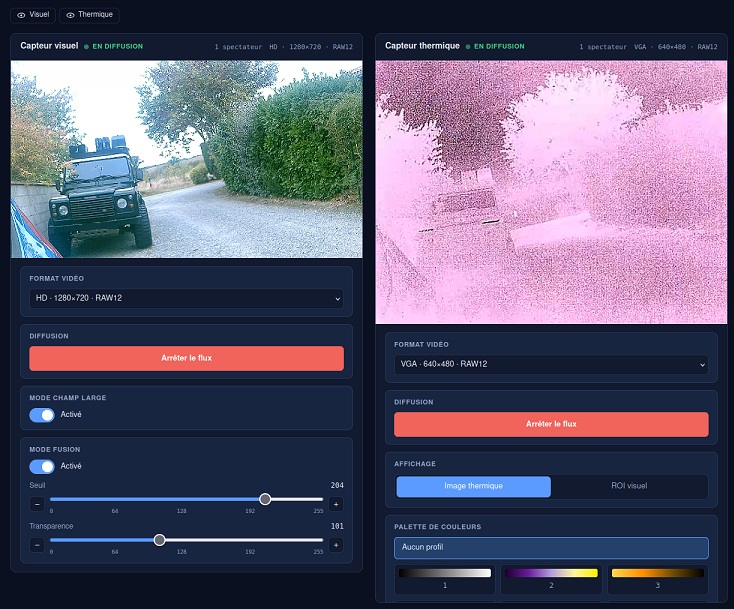
Test carried out with XPLOCAM connected to a 5G router. Visible and thermal streams are broadcast live, while fusion parameters are controlled from a remote workstation approximately 20 km away.
Visible only
Thermal only
Visible–thermal fusion
XPLOCAM · Test on 14 October 2026 · Successive captures, cropped without retouching
ARCHITECTURE & INTERFACES
Inside XPLOCAM: synchronised visible and thermal sensors, a CrossLink-NX FPGA pipeline and NVIDIA Jetson embedded computing.
The processing chain connects the sensors to the FPGA, then to Jetson and your applications. Video and network interfaces let you integrate this foundation into your environment.
Combine visible and thermal sensors.
Synchronise the sensors and control the pipeline.
Develop on Linux within the NVIDIA environment.
SENSORS & ACQUISITION
Sony IMX678 visible sensor, Lynred ATI640 thermal sensor, hardware synchronisation and MIPI CSI-2 acquisition.
INTEGRATION
Mini DisplayPort, USB-C and Gigabit Ethernet for displays, peripherals and communication.
DEVELOPMENT
Linux, a C++ API, ROS examples and the NVIDIA environment to develop your perception and AI functions.
APPLICATION AREAS TO EXPLORE
Explore potential applications. Each project starts by defining what needs to be observed, under what conditions, and what needs to be transmitted.
POTENTIAL APPLICATION
For a perimeter or a remote infrastructure site, network availability and installation conditions are part of the perception requirements.
What scene needs to be observed, and what video quality is required to use it remotely?
Bring processing closer to the site being observed and adapt the transmitted video to the available connection.
These examples describe potential uses to explore with you. They are not deployment references.
OUR DIRECTION
Only the essential data.
All the richness of meaning.
Why transmit and store data before it has value?
Our approach: start with local needs and transmit only what is useful. XPLOCAM is part of this vision for perception infrastructure.
LET’S DISCUSS YOUR ENVIRONMENT
Looking to develop with XPLOCAM or explore perception infrastructure? Tell us about your application, your environment and the information you need.
Tachysséma Développement
contact@tachyssema.frLet’s discuss your use case and the possibilities for integrating XPLOCAM.